
Echoes of Resistance: 25 Years Since Little Sisters v. Canada
In 2025–26, as Canada marks the 25th anniversary of the landmark Little Sisters Book and Art Emporium v. Canada Supreme Court decision, the Day of Pink theme, ECHO, reverberates powerfully. It is a celebration of resilience, of uncensored queer and trans stories, and of a pivotal moment in Canadian legal history where the rights to freedom of expression and equality were fiercely defended—though not without cost.
A Bookstore That Became a Battleground
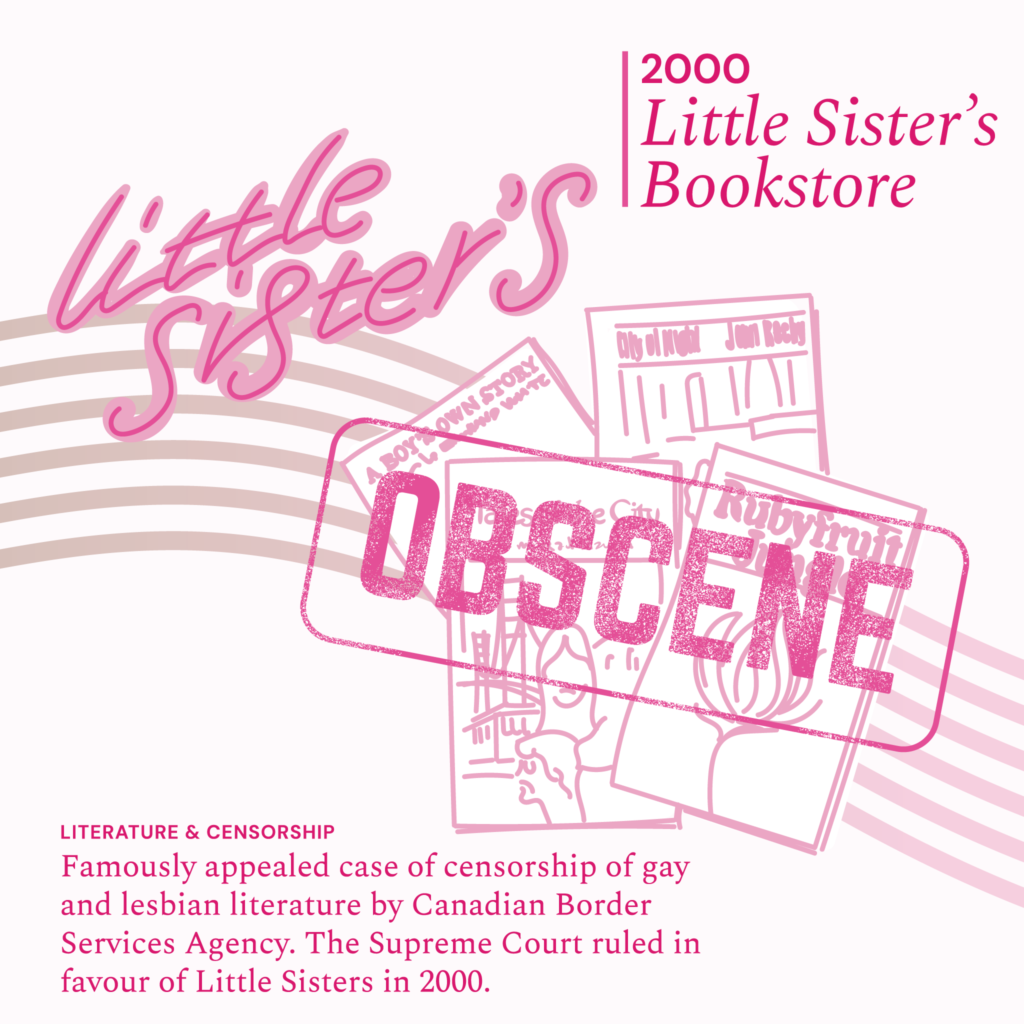
Little Sisters Book and Art Emporium, a modest queer bookstore in Vancouver, began as a sanctuary—a place where 2SLGBTQ+ people could see themselves reflected in the pages of novels, essays, health information, and art. But for over a decade, the store became the site of a national debate about censorship, equality, and state power. The Canadian government, through Canada Customs, regularly detained or outright banned materials bound for the bookstore under the pretense of obscenity—books that were freely available to mainstream (often heterosexual) outlets.
This selective enforcement did not go unnoticed.
In the landmark 2000 ruling, the Supreme Court of Canada held that Canada Customs had indeed violated Little Sisters’ Charter rights—specifically, their right to freedom of expression under section 2(b) and their right to equality under section 15(1). Crucially, the Court struck down the section of the Customs Act that placed the burden of proof on the importer. Going forward, the government had to prove materials were obscene, not the other way around.
The ruling did not eliminate Canada’s ability to block obscene content at the border. But it did force the government to justify censorship—a significant rebalancing of power in favour of free expression.
More Than Just a Bookstore
Little Sisters was never just about books. It was a political, cultural, and communal space—one that carried health information, and also academic texts, memoirs, zines, and histories that gave voice to lives and loves that had too often been erased. The state’s targeting of Little Sisters wasn’t just about policing content; it was about policing identities.
What made the case so monumental was its insistence that queer and trans people had the same rights to expression, dignity, and access to culture as anyone else. It set a precedent: that 2SLGBTQ+ voices mattered and deserved protection under the Charter.
But the victory was bittersweet. Even after the ruling, Little Sisters faced continued challenges. In 2006, they returned to the Supreme Court, not to fight censorship per se, but to ask the government to cover the costs of the ongoing legal fight—a rare legal request known as “advance costs.” The Court refused. Despite acknowledging the importance of the issue, it found the case did not meet the extraordinary threshold required.
This decision, while legally sound, effectively ended Little Sisters’ long legal battle. But the echo of their resistance endures.
A New Wave of Censorship?
Two and a half decades later, those echoes feel urgent again.
In 2025, the Alberta government announced new rules targeting “sexually explicit” material in school libraries. Education Minister Demetrios Nicolaides insisted it was not about banning books—but many of the titles flagged for removal were queer or trans narratives, including Gender Queer by Maia Kobabe and Fun Home by Alison Bechdel. These books, like the ones once detained at the border, are among the few that authentically reflect 2SLGBTQ+ lives for young people.
The parallels are impossible to ignore.
Once again, governments are drawing subjective lines between “appropriate” and “inappropriate,” with queer and trans stories disproportionately falling on the wrong side of that line. Once again, the burden of proof is unclear—and falls not on the state, but on communities defending their right to exist openly, and on educators and librarians forced into impossible roles.
And once again, as the ECHO theme suggests, we must listen to the reverberations of the past to understand our present.
The Power of Story
The Little Sisters decision didn’t end censorship in Canada. But it did send a powerful message: queer and trans stories matter, and the fight to tell them freely is a fight worth having. It established a foundation upon which generations have built community, identity, and resistance.
This 25th anniversary is not simply about legal precedent. It’s about legacy—the legacy of people who dared to demand dignity, the power of uncensored storytelling, and the reminder that access to information is not a luxury, but a right.
In a time when the battle over books has re-emerged, the Little Sisters case reminds us of the stakes. It reminds us that what we choose to silence—and who we silence—says everything about the society we are becoming.
As students, educators, writers, and activists gather for the 2025–26 Day of Pink, let this be a moment not only to remember, but to act. Because censorship has many forms. But so too does resistance.
And resistance, like the best stories, echoes far beyond the page.